jazz lessons

After one of our first gigs, someone came up and asked what kind of band we are. I wasn’t sure where she was going with this until she offered suggestions: blues? funk? soul? I’d thought it was obvious, but as she was asking I realized that it’s not at all. In fact, even if you ask the band and wait long enough, you’ll probably get six different responses from four different people.

The “Standards” in our name is reference to us as a jazz ensemble. We base a lot of what we play on a catalog of jazz standards: Fly Me to the Moon, Love Is Here to Stay, Melancholia, etc. are all in the standard jazz songbooks, both the ones you’d imagine and the physical ones that you could find in our bags. But then we play lots of other stuff upon which we paint a spectrum of jazz sensibilities.

It’s really hard to define because jazz takes its roots in blues and ragtime, expands with New Orleans marching processions, and then infects our culture in a wide array of ways, seeping into anything. We have soul, R&B, rock, and a wide variety of stuff all spilling out in the mid 20th century that you’d find specifically in the jazz section of a record store. But even that is so varied you’d have a hard time pinning it down. Wikipedia can’t make it any more clear, and paging through other descriptions leave it so open that you’d wonder if it’s all a practical joke.

One commonality in all of jazz’s descriptions is a nod to improvisation and syncopation. There’s a freedom that developed out of 12-bar blues riffs that continued to unravel into other forms with more possibilities. Maybe more important, there’s room for call and response, an interplay between members of the ensemble. Tim’s bass can take the rhythm so that Ian’s drums can fill. Caryn sings about a duck so Adam realizes that he should try to play a quack-like chord. We listen to each other and the result is something different than what we’d have had without the ensemble. More than the simple chance to improvise, there’s an invitation to listen to each other and see how this continues to feedback on itself.

As we’ve continued to play, I’ve learned that there are jazz standards that offer surprise. Some pieces like Orange Colored Sky sound simple and even campy if you aren’t listening. But the chord progressions are rich and complicated. Sure, the lyrics might be, “Wham, bam, alacazam,” but the notes are morphing with each count, up and down at the same time, sliding across keys in improbable but coherent ways. It’s a study in tonalities that you’d never hear in pop music.

Then, when we play something like The Middle — a song that doesn’t stray too far from 4 basic chords — there’s a blued fifth that I work into a D-minor chord. Tim slides the walking bass line; and Ian definitely throws in multiple rhythms. Caryn wails something that could be as true to a traditional blues tune as it is to this pop remake. We take something simple and play it slant. And, also, loud. (It’s one of our favorites.)

Is it jazz? It’s not Orange Colored Sky, but I’m going to say, “Yes.” I’m a little hesitant and start to step this back a little, especially as I imagine that there’s some purist out there (who would have called their own band simply “Standards”) who answers with a definite “no.” To us? We don’t care so much. We’ll keep seeing how we can throw in some syncopation and improvisation (it’s never the same thing twice), and most importantly make sure we have room for each other to throw in some off-beat, dischordant extra note.

Oh, and just to back us up that this is all okay, maybe that it even “counts,” here’s our friend Ella covering Cream. I think we’re in good company.

science love

As we all have multiple lives and pursuits, teaching gigs and family gigs in addition to our music gigs, it’s fun when some of these overlap. The College of Science at Weber State gave us this space to describe what we do, acknowledging Tim and Adam’s not-so-secret personas in chemistry and physics. (Our interview during the recent Van Session brought this up, too.) So Adam wrote up this piece on their webpage to describe the weaving of our multiple identities.

having fun

Since getting ready for the big public show at the Station and then getting our stuff recorded and out as demos, we’ve been looking forward to getting into a rehearsal that didn’t have any expectations, where we could just kick back and have fun. When you have a catalog of material that’s well rehearsed, it feels good to just enjoy it. This is the difference between “playing” and “practicing,” I suppose.

And yet, this morning when we got together for three hours we worked on all completely new stuff that we’d never played before.

This qualifies as real work. We picked through a few standards, some classic soul and blues tunes, a couple of obscure covers, and one that just came up in conversation and suddenly became part of an upcoming set list. One, a Bob Dylan cover, evolved through versions ranging from a straight torch song (too boring) to an uptempo bossa nova (fun to play, off-putting to listen to) to a twangy country romp (hilarious, but we respect our audience too much) to a smooth swing that Tony Bennett could sing in front of a big band–or, if you’re lucky, Caryn in front of our ensemble.

At my last count, I think we have nine new songs–pretty good for a Saturday morning. So much for taking it easy, but like everything else we’ve been doing lately, it turned out to be a lot of fun.

mixtapes at the Station

We’re really, really excited to get to play Jazz at the Station next week. This venue is made legitimate by a long list of accomplished and talented musicians engaged there each month. You should go even when we’re not playing, second Wednesday of each month. The music is good, it’s free (thanks to support of Weber County RAMP funding and the hard work of Caril Jennings and Benjamin Jennings), and it’s in a grand hall of an old train station. This makes it a great place to spend an hour, even if there weren’t music playing.

On Wednesday, there will be music playing and it will be ours. We hope to see you there:

Jazz at the Station
Ogden’s Union Station, Grand Lobby
Wednesday, January 9th, 2019
7-8pm

Besides rehearsing, we’re tasked with figuring out what to play. We’ve reached the point where we have material to choose from (in addition to new things we’d love to try out soon), and to squeeze it all coherently into an hour is a challenge. We’ve flashed back to making mixtapes for loved ones, an extinct hobby but one that is responsible for the existence of many of our students. How else would your parents have fallen in love with one another if it weren’t for the artful sequence from Peter Gabriel to Abba to Fleetwood Mac? Um … hypothetically speaking, of course.

Our setlist has some of the same considerations. How do you open enthusiastically but not too over-the-top? How do you sequence from one piece to the next, from fast to slow or from a standard to a re-invention? How do we make sure that Caryn has a chance to breathe in between songs? Where can we work in a subtle reference to trains? And, maybe most important, how do we build up and close the set? You’ll find out on Wednesday with an hour of music that spans most of the last century, but with our own recent spin and whimsy.

It’s us!!

practice and evolution

A recent archeological dig in my home revealed old binders and file folders of photocopied music that trace back to my earliest piano playing days. It’s comforting to find physical evidence of some of my memories, especially since I’m more and more unsure about these things as I get older. Tim and I have tried to explain this to the youth in our band.

The music that I’ve hung onto is not the old lesson books so much as the custom made arrangements of songs that a teacher would give me to try something new. It’s in these pieces of music where I can find roots of some of what I still remember and even how I play. There’s a copy of When the Saints Come Marching In, Silent Night, and the theme from the Mickey Mouse Club. In each of these there are handwritten chord progressions written above the melody line for the right hand. From these I learned how to play the notes of those chords in the left hand, and later my teacher taught me how to break up those notes of the chord in one way or another. I can still remember playing Silent Night with the stride of a bass note and two clunky triads in 3/4 time. It sounded just as good as you would imagine, like a clunky waltz being stomped out around a nativity scene. But it progressed into other things as well, with arpeggios in the left hand and accompanying harmonies in the right, and later in other keys to match up with a church choir at midnight mass.

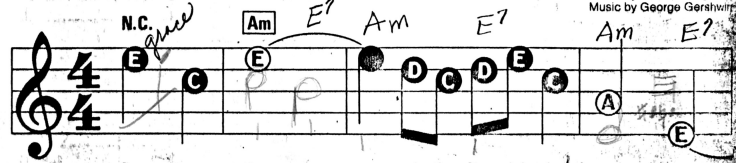
The most interesting revelation of the dive through my musical roots confirmed my memory of learning Gershwin’s Summertime. This was a “Big Note” version with the letters of each note written into their respective balloons, but it contained extra notation of grace notes, harmonies in the right hand, appropriate chords to fill out the changes, and hash marks to dictate a rhythm for the left hand. It was just what I’d remembered, though still astonishing to see this bizarre conglomeration.

summertimeclip.png

I wasn’t familiar with Summertime or even Gershwin until I’d had this piece written out and introduced to me when I was there in my piano lesson, a 13-year-old sitting stiffly on the bench while my teacher leaned over my shoulder to pencil in and explain these marks. But I’ve always come back to this, maybe because it was easy but probably more because there was so much to keep doing with this. During my first year of college I took one semester of jazz piano and learned that blues scales were a thing and that there were all these other voicings for those simple chords. It’s an easy song in a lot of ways, yet it’s also wide open to lots of variation and possibility. To this day, if you catch me cold and say “play something,” I’ll likely launch into this. (In fact, when Caryn first asked “What do you know?” this is exactly where we started.)

This progression and evolution of a song isn’t isolated to Gershwin in A-minor. Fast-forward from learning what a chord is to this past Thursday in rehearsal. We’d just stumbled into one song that we’d been sharing around, and then I started playing the chord progressions just to start to feel it out. For reasons I don’t fully understand, it started in a rhythm that fit a 5/4 time signature. (Count “1 – 2 – 3 – 1 – 2” over and over and you start to get a feel, especially if you syncopate a little in those first three counts.) I didn’t even realize that I was playing it until Tim pointed it out and I caught myself. I started to apologize for goofing off, but then one thing turned into another as we dared ourselves to try this out.  Soon, we’d worked on verses in 5/4 time, a chorus in 4/4, and then a kind of bridge in 3/4, with interludes that came back to the 5/4 to tie things together.

Let it be known: This was a stupid thing to do. It was also the perfect thing to do.

It took up half of our rehearsal time. And, this was after we’d said, “Let’s work on some easy things today.” But this is how the music evolves and it’s how — 35 years after my first piano lessons — I get pushed to learn and do something new. It’s a large part of the joy and benefit of playing with the band. I think at our next gig (at Cuppa on December 14th, 7:00 PM!) we’ll try out this self-imposed dare and see if we can stay together with the time changes. And, there’s a good chance that we’ll play Summertime, too.