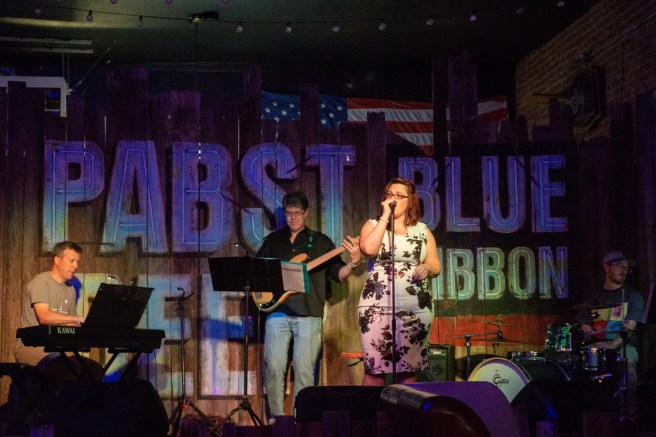
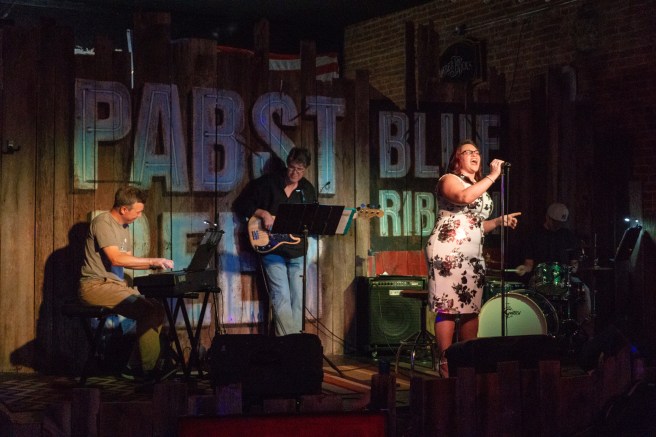
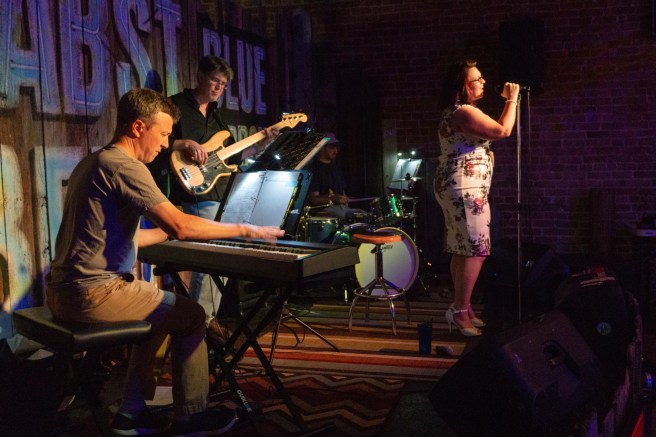
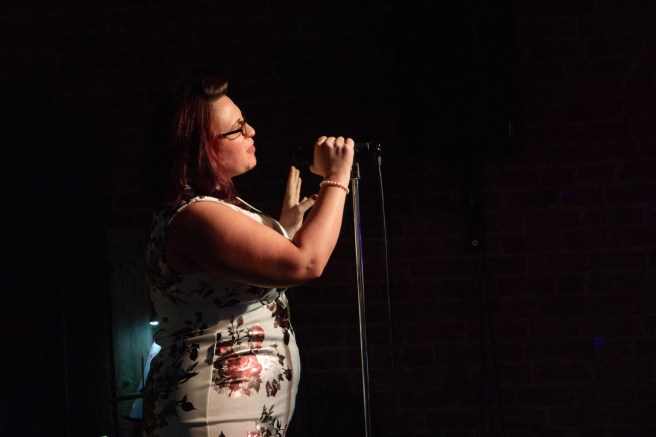
Maybe our natural habitat is an elevated stage at a bar on a Thursday night, Caryn breaking hearts while the boys work the groove in the background. We had a great time at Lighthouse and we’re already following up on an invitation to come back. Thanks to all who came out and cheered us on.
This Thursday, June 6th, we get to play at the Lighthouse Lounge here in Ogden. “Ogden Unplugged,” an open mic opportunity, runs from 7:00 to 9:00 PM. Then we get to take the stage at 9:00 until 11:00 PM. Event details are posted here on Facebook — but that pretty much sums it up. No cover, and come as you are for as long as you’d like.
This is our first chance to play here, and we got even more excited after hanging out for a few hours watching Scott Rogers hold court and endure our heckling. Ian and Caryn are just finishing out their school years and packing up classrooms, while Tim and Adam are each flying back from different work trips in different time zones, all collecting back together just for this. We put together a set to take full advantage of the two hours; and we hope you all take advantage of the laid back vibe (couches and coffee tables or tall tables with bar stools or anything in between). Hang out with friends, and if you occasionally take notice of something we’re playing, so much the better. We’re really looking forward to it.
First, we play at DaVinci Academy’s Jazz Night on Friday, May 24th, 7:00 PM. Details here, along with a link for tickets. We’ll back a few of their vocalists along with something from our own catalog.
Then, for the over-21 crowd, we play at Lighthouse Lounge in Ogden on Thursday, June 6th. Details here on the Facebook event page. There’s an open mic acoustic set from 7-9 PM, and then we get to play as the featured artist from 9-11 PM.
We’re playing Cuppa this Friday, May 3, from 6-8 PM. (Note the change in Cuppa’s hours.) This coincides with First Friday, so it’s a good chance to get dinner — their “Sloppy Jack” is my favorite — sit in for a set, and then stroll the art galleries down the street and still have time left in your evening.
After one of our first gigs, someone came up and asked what kind of band we are. I wasn’t sure where she was going with this until she offered suggestions: blues? funk? soul? I’d thought it was obvious, but as she was asking I realized that it’s not at all. In fact, even if you ask the band and wait long enough, you’ll probably get six different responses from four different people.
The “Standards” in our name is reference to us as a jazz ensemble. We base a lot of what we play on a catalog of jazz standards: Fly Me to the Moon, Love Is Here to Stay, Melancholia, etc. are all in the standard jazz songbooks, both the ones you’d imagine and the physical ones that you could find in our bags. But then we play lots of other stuff upon which we paint a spectrum of jazz sensibilities.
It’s really hard to define because jazz takes its roots in blues and ragtime, expands with New Orleans marching processions, and then infects our culture in a wide array of ways, seeping into anything. We have soul, R&B, rock, and a wide variety of stuff all spilling out in the mid 20th century that you’d find specifically in the jazz section of a record store. But even that is so varied you’d have a hard time pinning it down. Wikipedia can’t make it any more clear, and paging through other descriptions leave it so open that you’d wonder if it’s all a practical joke.
One commonality in all of jazz’s descriptions is a nod to improvisation and syncopation. There’s a freedom that developed out of 12-bar blues riffs that continued to unravel into other forms with more possibilities. Maybe more important, there’s room for call and response, an interplay between members of the ensemble. Tim’s bass can take the rhythm so that Ian’s drums can fill. Caryn sings about a duck so Adam realizes that he should try to play a quack-like chord. We listen to each other and the result is something different than what we’d have had without the ensemble. More than the simple chance to improvise, there’s an invitation to listen to each other and see how this continues to feedback on itself.
As we’ve continued to play, I’ve learned that there are jazz standards that offer surprise. Some pieces like Orange Colored Sky sound simple and even campy if you aren’t listening. But the chord progressions are rich and complicated. Sure, the lyrics might be, “Wham, bam, alacazam,” but the notes are morphing with each count, up and down at the same time, sliding across keys in improbable but coherent ways. It’s a study in tonalities that you’d never hear in pop music.
Then, when we play something likeThe Middle — a song that doesn’t stray too far from 4 basic chords — there’s a blued fifth that I work into a D-minor chord. Tim slides the walking bass line; and Ian definitely throws in multiple rhythms. Caryn wails something that could be as true to a traditional blues tune as it is to this pop remake. We take something simple and play it slant. And, also, loud. (It’s one of our favorites.)
Is it jazz? It’s not Orange Colored Sky, but I’m going to say, “Yes.” I’m a little hesitant and start to step this back a little, especially as I imagine that there’s some purist out there (who would have called their own band simply “Standards”) who answers with a definite “no.” To us? We don’t care so much. We’ll keep seeing how we can throw in some syncopation and improvisation (it’s never the same thing twice), and most importantly make sure we have room for each other to throw in some off-beat, dischordant extra note.
Oh, and just to back us up that this is all okay, maybe that it even “counts,” here’s our friend Ella covering Cream. I think we’re in good company.


 Standards & Substandards