Here’s all we’d say if we had room on the actual album cover for commentary. I’ve long admired liner notes, like those written by Bill Evans on the Miles Davis classic, Kind of Blue. And that’s made me think that it must be the piano player’s job to write the liner notes for an album. So here’s my (Adam’s) take on what we’ve done, though everyone chimes in.
Post Office Sessions (2026)
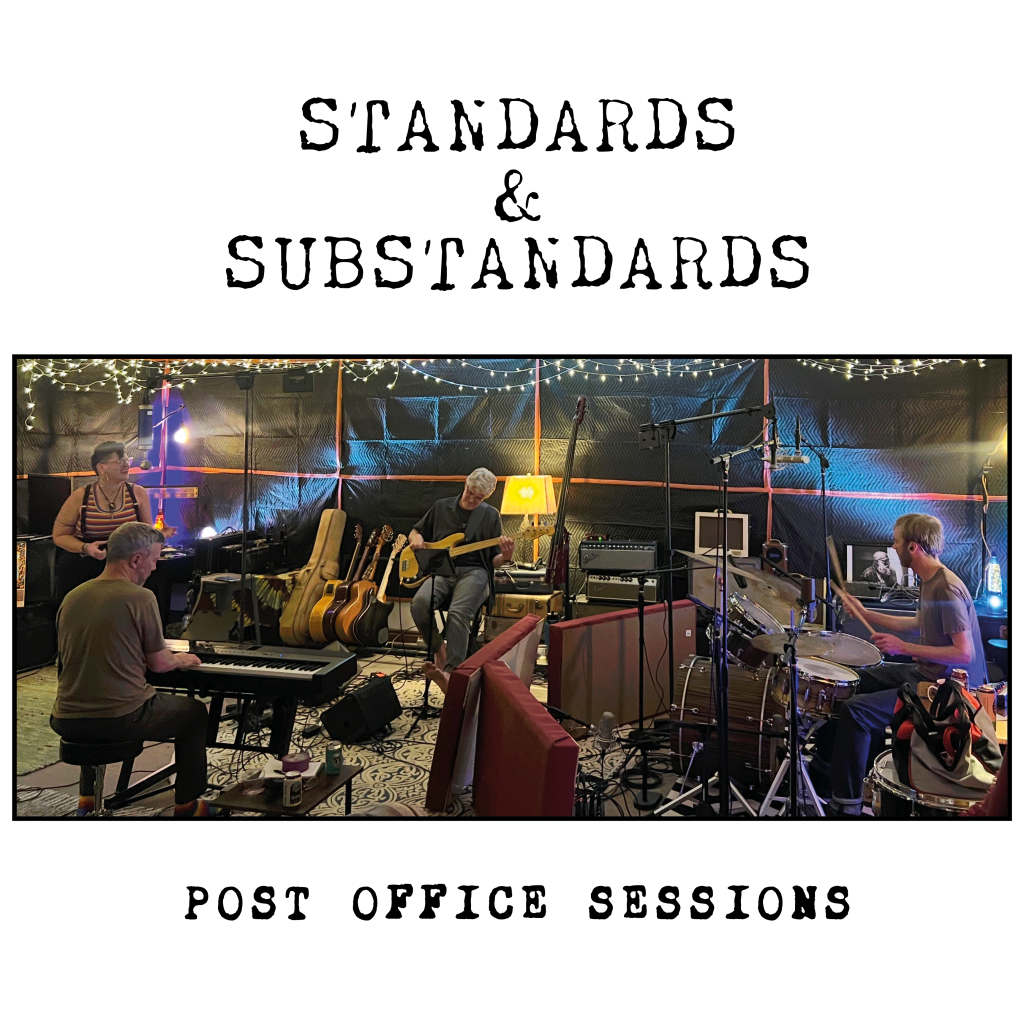
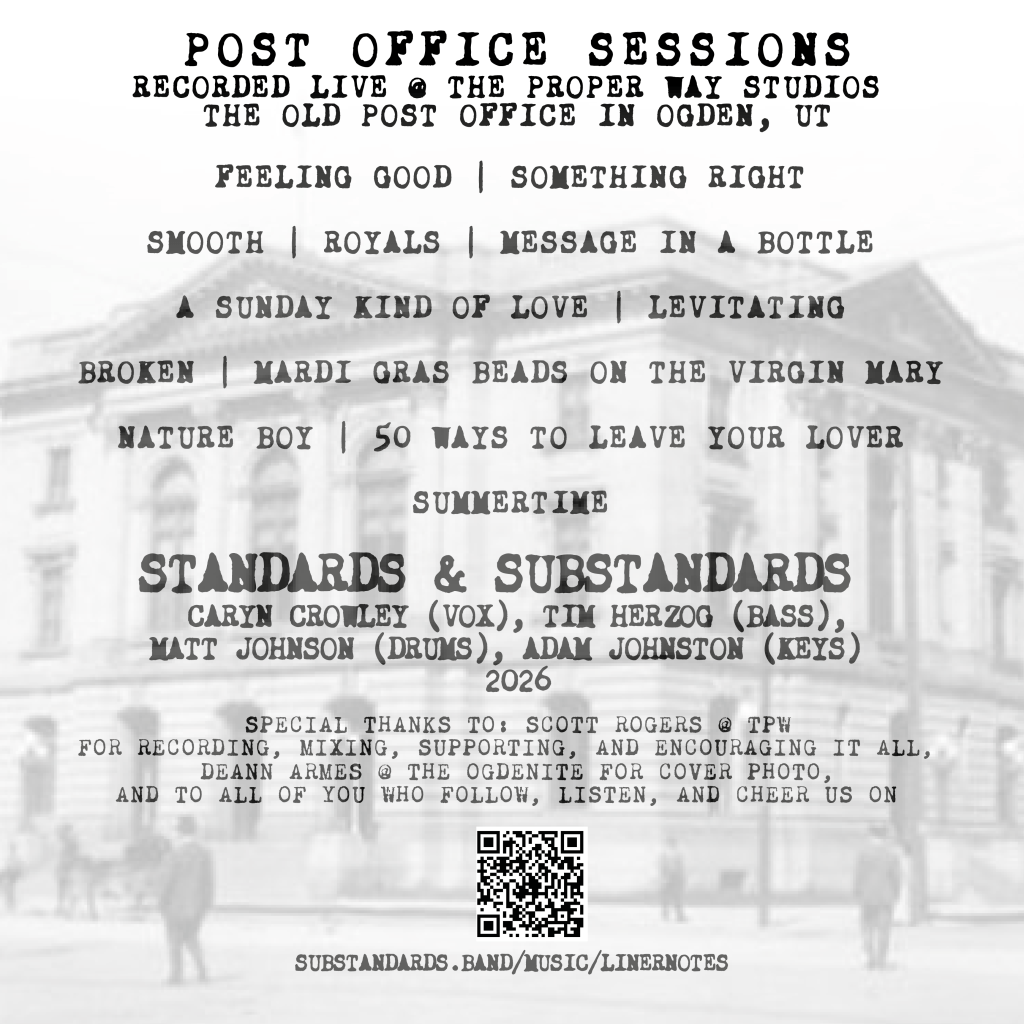
Post Office Sessions is so named for its production in the basement of the Old Post Office building in Ogden, Utah, an iconic and historic cornerstone of the band’s hometown. It has housed plenty of notable associations, the most important of which is the underground residence of The Proper Way Studios. This is where we were able to record out in the open, monitors bleeding our sounds into the room (rather than headphones) so we could hear ourselves just like we do in our most comfortable live settings. We leaned in even more by inviting people into the studio to hang out and cheer us on or, sometimes, stay absolutely quiet as we’d let a song hover in stillness as we finished. They were also gracious enough to allow us some false starts and a few extra takes; but they also got to witness single takes and moments that just materialized out of the ether. Heckling, banter, and shoutouts were provided in appropriate portions.
Scott Rogers of TPW was at the helm for all of this, piping all the sound through the cables and both into the speakers in the room and his recording console. He not only put up with us, but helped us visualize the entire concept; and then encouraged all of it from start to finish, everything from the setup to the final mastering and all the counseling in between. Most important, Scott is a genuine supporter of music and musicians in Ogden, and we know we’re not alone in saying that his generosity in giving of his time, advice, and community building is at the core of our music community — as well as any success we might be lucky enough to find.
Here’s the track-by-track description of what resulted.
- Feeling Good
“Hit it.” This is Caryn’s prompt for Tim’s intro bass line. It seemed fitting to leave it in and open the album this way. This Nina Simone standard has become a staple in our setlists. - Something Right
An original song written after Adam realized that a lot of jazz standards in the American songbook are just a series of whimsical rhymes and aren’t actually all that serious. Go figure. We don’t actually drink whisky in the morning, but it’s a fun opening line. Features Caryn’s whistling, which always gets attention. - Smooth
Caryn will tell you that she always had a vision for this arrangement even before she’d met the rest of the band. It’s got a much different groove than the Santana/Rob Thomas original, but listen for Matt’s homage on the hi-hat at the very end. - Royals
The day of our recording marathon, we’d taken a break for dinner and then brought in our main assembly of audience members for the evening. You can probably feel the froth of energy in the room coming from both the band and the people in the wings. Our arrangement of this song moves from a minor key to a major key to a blues mode. You might not have noticed so we thought we should tell you. - Message in a Bottle
We recorded this because there’s a lot that goes on as the song progresses, and often it all goes unnoticed in the din of a bar or gets mixed in with conversation at the lounge. We leaned into the instrumental and let it play out, led by Tim and letting Adam and Matt play along as it builds and fades back to the vocal verse. - A Sunday Kind of Love
We’d learned this for fun after learning that one of our wedding couples really liked this song. (They’d requested At Last for their first dance, another Etta James staple.) Now it’s a favorite of ours. Also, just for your information: we’ll learn your favorite song, too, if you hire us. - Levitating
We love Dua Lipa. This is completely different from the song she originally recorded, but we’d like to think she’d enjoy this and want to hang out with us. If you know her, have her give us a call. - Broken
This is our first original song and a departure from the style of anything else we’ve done. It’s evolved through at least three different keys and twice as many styles between Adam’s demos and the band’s interpretation after convincing Caryn to take the lead. All the lyrics are literal and truthful: “missed a step … hit the wall” is a retelling of the way a wrist was broken; and everything else, even cryptic and metaphorical sounding, is based on actual happenings. But it doesn’t matter what they are or where they came from if you have your own association with them. The point is probably that there’s no such thing as “healed,” only active healing. We can break, but we’re not broken. - Mardi Gras Beads on the Virgin Mary
Our most recent original. Adam was walking through the grounds of a parochial school and saw that someone had draped mardi gras beads on a statue of the Virgin Mary. So, that’s a song that kind of wrote itself and later got fleshed out in Tim’s basement with the band. I had started to worry that maybe the satire was too over the top, and then I listened to some Randy Newman. I’d also worried that maybe the song’s point wouldn’t be relevant in a few months. No such luck. - Nature Boy
What do David Bowie and Nat King Cole have in common? This song. If you think it’s super weird, we’d fully agree. We love it. - 50 Ways to Leave Your Lover
We almost didn’t include this on the list for our recording session, but we couldn’t not highlight the fun we have digging into the groove and especially Matt’s drumming. After all, Scott had set up a dozen mics around the drum kit and it would be a shame to not take full advantage. - Summertime
This song was the original seed of our band, played when Caryn and Adam met. The riff on Beethoven in the intro was a favorite feature of Caryn’s mom, so Adam will always keep it in. - (Wiped Out)
Not widely released, but if you’re lucky enough to get a CD you’ll find this easter egg. It’s an impromptu instrumental taken up late in the night when we were tired and punchy. Listen carefully and you’ll hear Matt saying that he couldn’t possibly play this. So we did.
Videos of Us in Handcuffs (2022)
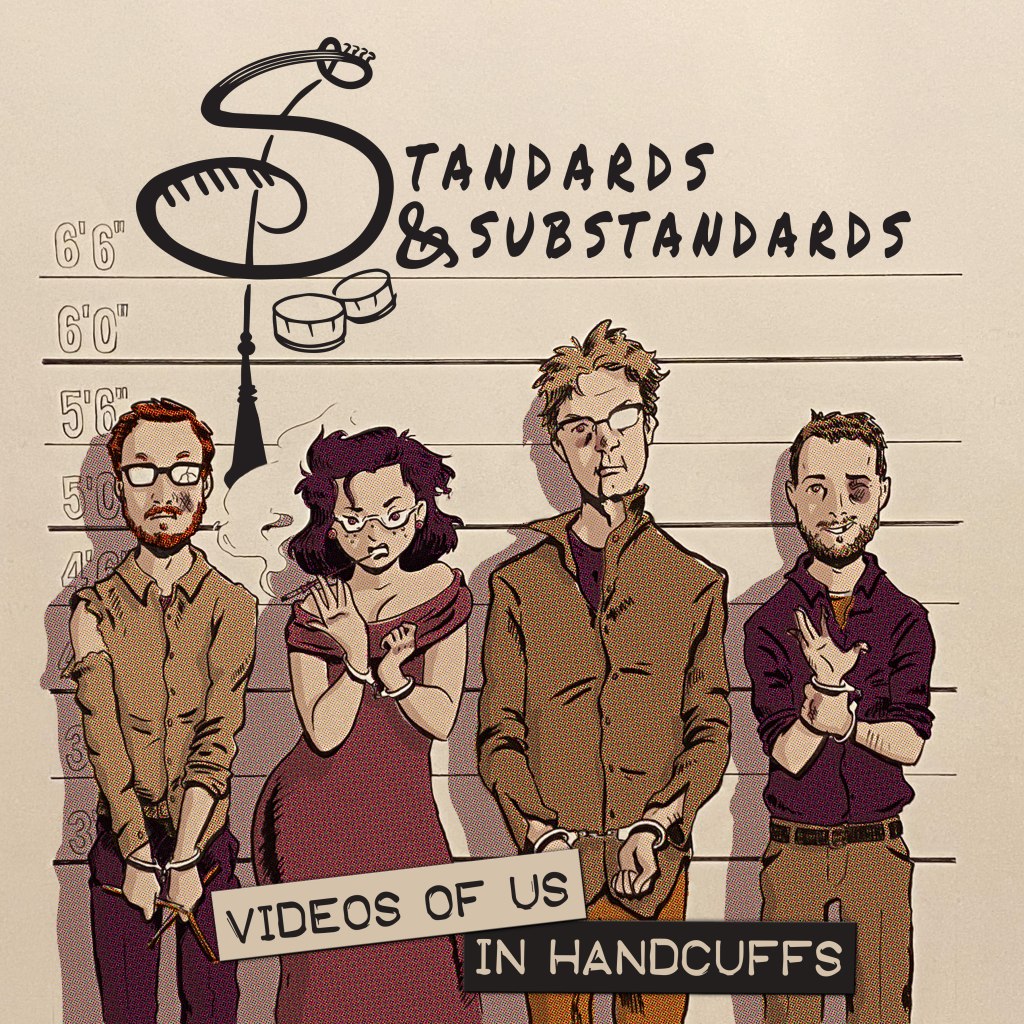
Through 2022 we kept intending to get back into the studio, or at least Tim’s basement, and really work out some polished recordings. But then we kept booking these great live gigs that included everything from backyard patios to concert stages. Whenever we were mixing our own sound we’d press a red button that recorded tracks, documenting all the vibrations unique to each setting. We realized that live gigs are where we experience the spirit of playing that we love, in the moment. This is our attempt to preserve and share that.
Creep (live)
Caryn riffs about how hot it is during this patio party gig, and then we realize collectively that we have to make up an impromptu ending.
Orange Colored Sky (live)
“Flash, bam, alakazam.” This is a fun and funny song. It’s been performed by Nat King Cole, Lady Gaga, Adam West (Batman!), and us, among many others.
I Will Survive (live)
You’d never guess from listening, but we have video to document it: Caryn belted this out from a seated position with her newly broken leg propped up on a stool.
A Change Is Gonna Come (live)
It took us a while to convince ourselves that we could come anywhere near doing this song justice. We just decided to lean into it.
I Want You Back (live)
In which you will hear Ian talking about his dream that we “get the cops called on us,” imagining the fame we’d get from the “videos of us in handcuffs.”
Standards & Substandards is: Caryn Crowley, vocals; Adam Johnston, keyboard; Tim Herzog, bass; Ian Marshall, drums. All songs recorded and mixed by Standards & Substandards, except I Will Survive, recorded live by Scott Rogers for Van Sessions, mixed by S&S. Album art by Leslie Hetland. Logo by Meagan Crowley.
(c) 2022, Standards & Substandards
for our self-titled album (2019)
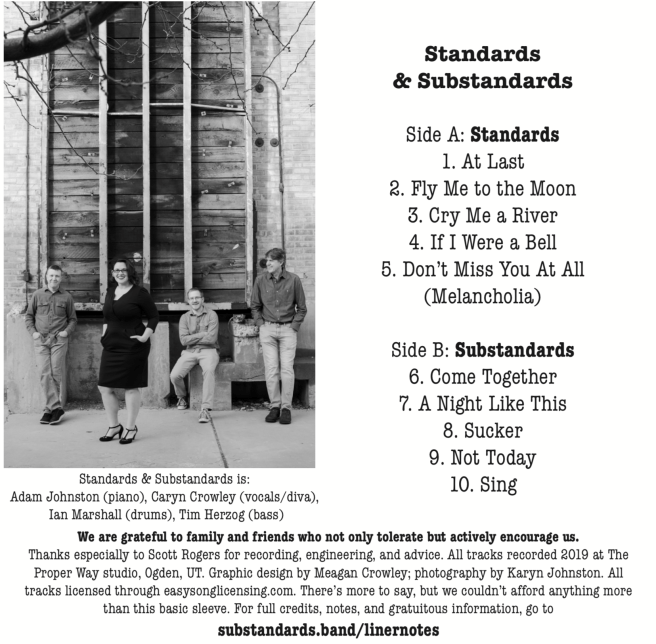
This is our self-titled album, Standards & Substandards. We’d thought of other names for it (Consignment Store Sessions; Songs for Geckos; Unfortunate Introductions; etc.), but frankly there’s nothing more to be said besides the band name, invoking our contrasting sides and what this might look on a traditional vinyl record, one with jazz standards and the other with those songs that we’ve crafted to our own stylings.
When we started playing together — a happenstance miracle that could have only been initiated at one moment in time when we were all assembled by children and forces of the universe — we had no real idea what this would become or if we’d ever do anything more than play in a vegan coffee shop. But one thing led to another and now we get to play bars, weddings, back alleys, consignment stores, markets, and even a studio. And we’d still happily play a vegan coffee shop. Or anywhere, for that matter, because it’s not the output or setting that’s important, as proud of this recording as we are. It’s all in the moment of playing. If you’ve ever been in a dive bar playing a jazz cover of a Sesame Street song and realized that some of your best friends are playing all of the other notes and hits in between everything you’re playing AND there are random people surrounding you all singing along joyfully … well, then you’d understand.
Side A: Standards
At Last (Gordon & Warren)
This is one of the first songs we worked out as a band. Caryn jokes in live performances that any number of people might fall in love with her by the end of this song. Frankly, it’s a pretty serious risk. We’ve witnessed it firsthand.
Fly Me to the Moon (Howard)
A jazz standard that we can play over and over and over. In part, this is because we play it so fast it only lasts 90 seconds. If you’re getting married and you want this for a dance, we’ll slow it down. Maybe we’ll add another instrumental. That should make it last a whole 120 seconds. Funny thing is that I think Ian would play it even faster if he had a chance, and one time he counted it in about 50% faster — just to be funny — and almost gave Caryn a heart attack. Comedy gold.
I think it’s also good to point out that this is the only track you hear anyone’s voice besides Caryn’s: Ian counts us in. In all of these tracks, he’s in an adjacent room with an array of microphones and we all look through that doorway for his cues.
Cry Me a River (Hamilton)
I heard this in the end credits of a The Marvelous Mrs. Maisel episode one night and immediately knew that this is a song that suits us, bluesy and dark. I think Caryn saw the same episode that week and thought exactly the same thing. This is the kind of melancholy that you should play late at night, in the dark, turned up enough to let Tim’s bass shake your floorboards.
There are moments of songs that I cherish. In the bridge of Cry, there’s a downshift that Tim makes on the bass, followed by the sweet major seventh chord and Caryn singing the word “plebeian” (look it up); and then immediately after there’s this sordid, minor change that inspires me to crunch together two dissonant notes as she sings “through with me” and we rally into the emphatic final verse. I just really love that and I’d hoped someone would notice.
If I Were a Bell (Loesser)
At its face, this is a ridiculous song. “If I were duck, I’d quack … If I were a salad I know I’d be splashing my dressing … If I were a bell I’d go ding dong ding dong ding.” But like so many standards it’s spectacular in its complexity. I know you think I’m being facetious, but this song is really hard to get right. Like so many standards, the chord changes are surprising and the rhythm is relentless. People don’t write music like this anymore, which is too bad. It’s become one of our favorites.
Don’t Miss You At All / Melancholia (Ellington & Jones)
We joke about how some members of the band might not always share their feelings, or even admit that they have emotion. But our deep reaction to this achingly beautiful song proves that all wrong. It’s based on a Duke Ellington piano standard, with lyrics added by Norah Jones. This is one of those tunes you can play on a piano to really understand what that piano is like, down in its soul, underneath the strings and soundboard.
Side B: Substandards
Come Together (Lennon & McCartney)
It’s wrong to try to emulate The Beatles, so we just take this incredible song, work in some blues scales, run a funky bass line, and drive it with some effervescent percussion. Caryn sings all the right words, too.
When we play this live, we’re never sure exactly what it’s going to be until we start. Lately, we’ve been playing the tempo much slower and just kind of dig into the blues groove of it. But on any given night it could be different, depending on what we build from Tim’s bass line.
A Night Like This (Schreurs, Van Wieringen, & Degiorgio)
Tim brought this to us from out of nowhere and immediately convinced us that it was worth trying out. It sounds like it should be a standard that’s decades old, but it’s contemporary. And Scandinavian. I don’t know how to categorize this modern classic, Scandinavian Latin, substandard standard. I guess that makes it perfect for us. Also, Caryn whistles, which is always fun.
Sucker (Jonas et al.)
I remember the day Caryn brought this to us. Really, the Jonas Brothers? She said yes, and that she was thinking it would have some kind of syncopated Latin rhythm to it, the most ridiculous thing I’d heard that day. And then five minutes later Ian was running through terrific percussive riffs, as he does. And then Tim threw in the bass line, and I just had to learn how to make sure not to mess it up, keeping the piano underneath it all. There are drum interludes that I truly don’t understand in here, but I’m glad I just kept counting to four and keeping up. I desperately want to watch Ian when he’s playing, but I know it would just make me dizzy and I’d mess up my own part.
Not Today (Caracciolo)
Alessia Cara wrote this honest song about what being down or depressed really is. Sometimes we get submerged by the weight of things and it’s right to honor that. We try to torment this even more by stripping the song back and slowing it down and making sure we emphasize all the minor tones. Listen to the second line where Caryn blues the note. We just follow along as we layer more behind her.
Sing (Raposso)
When I saw Sesame Street Muppets playing a Tiny Desk concert (watching it for yourself will be the best thing you’ll do all day), I immediately messaged everyone else in the band and said that they should watch it and that Sing could be a great song for us. I have a healthy record of dumb ideas, so it’s remarkable that everyone agreed and that it’s become one of our favorites. Once we get going on this one, you get to hear each of us playing off one another. I can’t begin to explain what this feels like, especially in a basement bar when you suddenly realize that people are singing along.
In our take on this, Caryn takes the lines, “Sing of good things, not bad;
Sing of happy, not sad,” and slyly sings “and” instead of “not,” embracing the good and bad and happy and sad. Not to put too fine a point on it, but this is what we’re about — and I’m confident that plenty of lessons from Sesame Street would back us up. Melancholia is every bit as therapeutic as At Last.
“Sing” is literal and metaphorical. Unapologetically go forth and celebrate what you and your band bring: Hit the drum, pound the keys, pluck the string, and sing a song. It’s all good and worthy. “Sing out loud, sing out strong” along with us in the bar next time you see us. We’ll welcome your voice.
And finally: Thanks
We are grateful to family and friends who not only tolerate but actively encourage us. Thanks especially to Scott Rogers and The Proper Way studios for recording, engineering, and good advice. Graphic design by Meagan Crowley; photography by Karyn Johnston.
All tracks licensed through easysonglicensing.com; IDBLM 163226.
 Standards & Substandards